
ALL AMIDST THE GARDENS FAIR; OF HESPERUS, AND HIS DAUGHTERS THREE; THAT SING ABOUT THE GOLDEN TREE. An original watercolour illustrating John Milton's Comus.
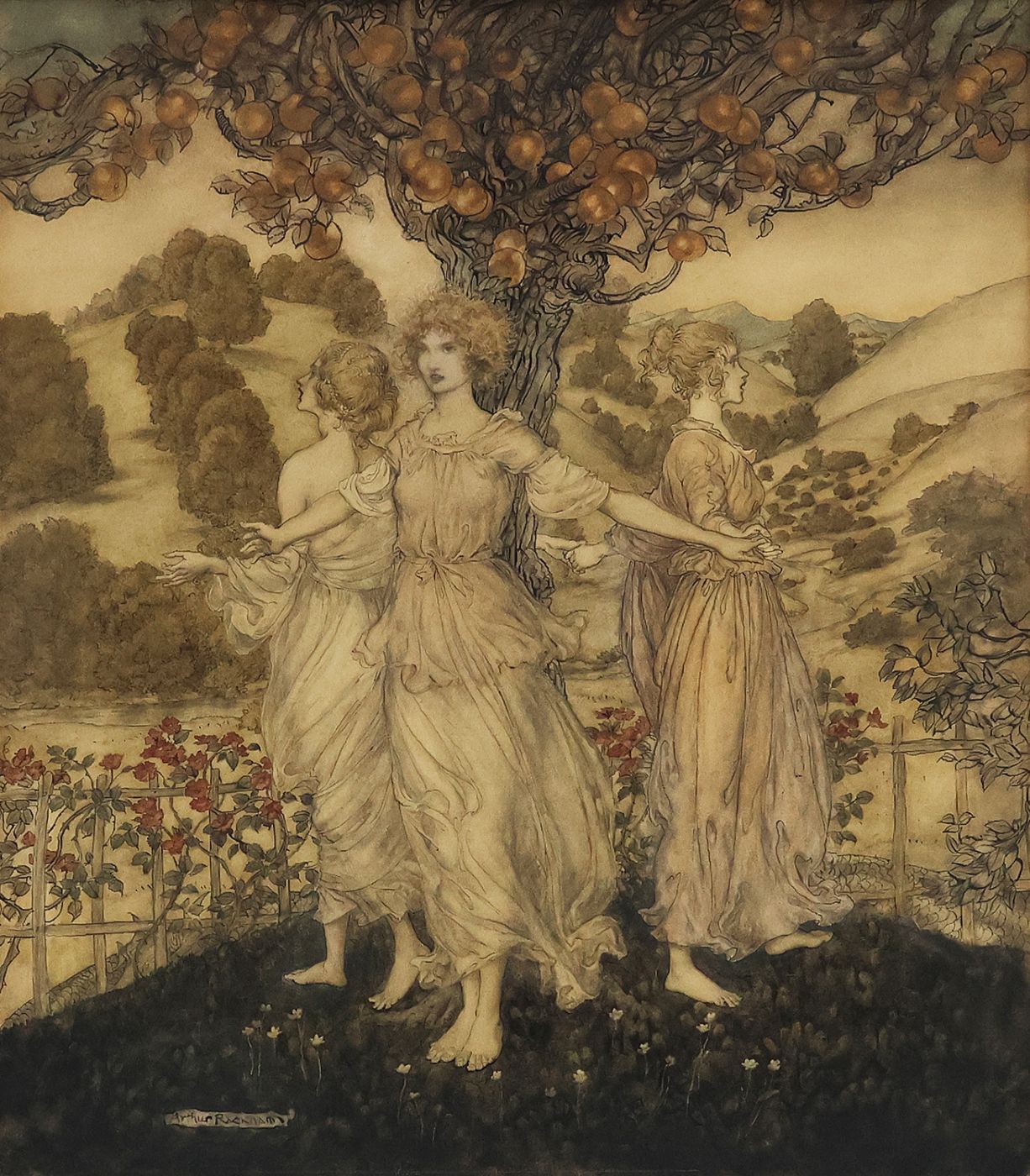
An original illustration by Arthur Rackham, reproduced as the frontispiece for the 1921 William Heinemann edition of John Milton's 'Comus'. Depicting the three Hesperides, the nymphs of evening, guarding the tree of golden apples before a backdrop of rolling hills and a rose-covered fence. A hint of the dragon Ladon can be seen just beyond the fence. Beautifully rendered in watercolour and ink and displaying Rackham's distinct use of deep, muted colours. Signed to the bottom left. Retaining the contemporary thin oak frame and backboard with New York gallerist's label. Remounted using archival, acid free materials and glazed with replacement museum quality UV glass. The illustration measures 26.7 x 30.5 cm, and the frame measures 51.8 x 64.5 cm. In fine condition, the colours rich and without fading.
This stunning original artwork, with its lush detailing, refined brushwork and sensitively drawn figures, shows Arthur Rackham (1867-1939), master of The Golden Age of Illustration, at his absolute best. The composition and imagery of the draped nymphs holding hands around the golden apple tree are reminiscent of the Pre-Raphaelite artist Edward Burne-Jones' (1833-1898) c. 1870 painting 'The Garden of the Hesperides', just one of Burne-Jones' many depictions of the Hesperides, a subject that reflects the mythic and nature-based predilections of the late Victorian artistic imagination that maintained a thread from the Pre-Raphealite Brotherhood through to the Art Nouveau illustrators of the early 20th century. Rackham produced 24 colour illustrations and numerous line drawings for Heinemann's edition of John Milton's masque 'Comus', originally planned for publication in 1915 but pushed back to 1921 due to uncertainties in publishing during World War I. Fred Gettings notes that by the 1920s a 'softening' is discernible in Rackham's style, citing his illustration of the Hesperides as an example of a reduction in the use of graphic ink lines and an increase in tonal painting techniques to create subtle definition. Indeed, while delicate ink lines are used for the perimeters of the nymphs' forms, their features and much of their bodies are indicated with very soft paint work, lending them an angelic quality that strays slightly from the heavier, folkloric essence of Rackham's earlier titles such as 'Peter Pan' and 'A Midsummer Night's Dream'. 'Comus', an allegorical morality tale exalting chastity, was written by John Milton (1608-1674) in 1634 and was presented to the 1st Earl of Bridgewater at Ludlow Castle. The masque begins with two brothers becoming separated from their sister while travelling through a forest; the lady is enchanted and tempted with debauchery by Comus, the Greek god of revelry. The brothers are then visited by an angelic attendant spirit who summons the virgin nymph Sabrina to break Comus' spell. Victorious, the spirit sings a song that describes the celestial realm to which he will now return, including the idyllic garden of the Hesperides. Provenance: Scott and Fowles, 667 Fifth Avenue, New York.
Stock code: 29533
£35,000
Published:
Category
Modern First EditionsChildren's / Illustrated
Gift Ideas
Original Artwork
Recent Acquisitions
Science Fiction / Fantasy
Signed / Inscribed