

WAR-SHOCK. The Psycho-Neuroses in War Psychology and Treatment.



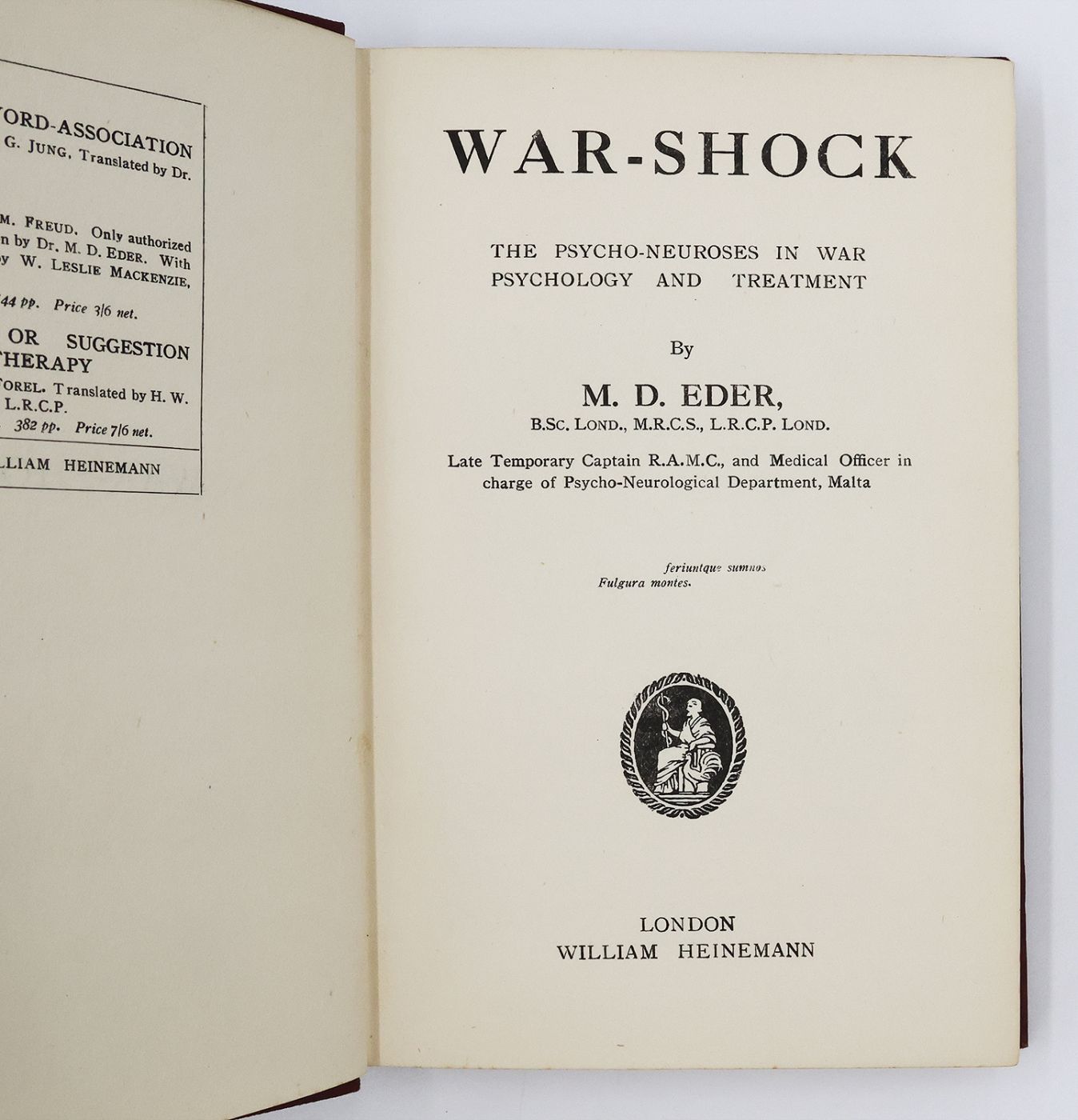
First edition, first printing of the first work of psychoanalytic writing on war neuroses to be published in book format. Publisher's original burgundy pebble grained cloth, ruled in blind to the upper board and with titles in gilt to the spine. Illustrated with two diagrams (p.34-35). A better than very good copy, the binding square and firm, with a little bumping to the spine tips and corners, the cloth and gilt titles are bright and fresh. The contents, with some offsetting to the endpapers, a little bleed from the cloth to the extreme edge of the prelims, and just the occasional small finger mark to the margins, are otherwise clean throughout and without inscriptions or stamps. An attractive example of this landmark work. Scarce.
The first book-length psychoanalytic study of war neuroses, by British physician and psychoanalyst David Montague Eder (1865–1936). In his examination of the hysterias, diagnoses, and treatments associated with "shell-shock" (now recognised as post-traumatic stress disorder), Eder drew on the first one hundred consecutive cases of psychoneuroses under his care while serving as medical officer in charge of the psycho-neurological department in Malta during the First World War. The volume's appendix includes a detailed table of all one hundred cases, recording the soldiers' ages, lengths of service, symptoms, treatments, and outcomes. The term "shell shock" was first introduced in a 1915 article in The Lancet by Charles Myers of the Royal Army Medical Corps, initially to describe a physical injury to the nervous system caused by heavy bombardment. It soon became apparent, however, that soldiers indirectly exposed to shell fire exhibited comparable symptoms, leading medical officers such as Eder to propose a psychological origin. At the time, "shell shock" was neither formally recognised as a mental disorder nor treated with consistent sensitivity, as both military authorities and patients themselves were under intense pressure to return affected men to active service as quickly as possible. The precise number of soldiers who suffered from shell shock during the war and its aftermath remains contested, with estimates ranging from 80,000 to over 250,000 men.
Stock code: 29258
£375
Published:
Category
Modern First EditionsNon-fiction
Recent Acquisitions
Science
History / Military